
Sometimes, a TV spin-off doesn’t just justify its existence — it outshines the show that spawned it. In our franchise-obsessed media culture, when a show is a big hit, there’s immediate talk of how many spin-offs it can spawn. That’s despite the fact that TV history is littered with dismal failures on that score — for every “The Jeffersons,” there’s a “Joey” or “The Brady Brides.”
For a spin-off to work, there generally has to be real effort and resources behind it — if you want a “Game of Thrones” prequel like “House of the Dragon” to succeed, you have to be able to afford some dragons. It’s no longer enough to take a secondary character and drop them into a new family in a different city. Sometimes, just sometimes, though, a spin-off actually exceeds its source material. They aren’t common, but they do exist, and we’ve rounded up ten of them.
The rules for this list are simple: The spin-off can’t just share a universe — it must feature at least one character who appeared on both shows. Being as good as the original is not acceptable; it must be better. And finally, we only allowed one “Star Trek” entry, even though there could’ve been more.
Frasier
“Cheers” was very good. “Frasier” was even better. “Cheers” was a show for everyone, brilliant in its simplicity: What if regular bar conversations could be made more universally entertaining? Think the casual flirtations, clashes of smart and stupid, and the unloading of personal issues. All the things people normally talk about in bars, put in the mouths of series regulars who could express them more eloquently than you or me, became storylines viewers cared about.
“Frasier” took the show’s most overtly intellectual character and placed him in new circumstances designed to put him at both his most comfortable (dispensing advice) and most uncomfortable (living with his blue-collar father). Paired with his equally condescending intellectual brother Niles, Frasier could drop highbrow references not every viewer would get, while being thrown into very human situations that exposed the limits of his high IQ. Even the most accredited therapist in the world can’t understand what women want in a man…or how to make a stubborn dog come when called.
Stage-trained Kelsey Grammer never played Frasier Crane as knowingly funny, which is why he was, especially opposite John Mahoney as unfiltered ex-cop Martin Crane. “Cheers” had most of its intellectual versus practical conflicts in the battle of the sexes: Sam versus Diane or Rebecca. Both of those conflicts found resolution, but framing the same arguments as a generation gap and roommate feud allowed them to continue indefinitely. At least until the reboot, made after Mahoney died, which lost a step because of it.
She-Ra: Princess of Power
When Mattel created the Princess of Power toy line to appeal to girls, featuring He-Man’s sister She-Ra, it was all very doll-like and safe. Figures included removable outfits and combable hair, characters rode swans and pink horses, and the meanest villain in the line was a “jealous beauty” named Catra.
When Filmation created the animated spin-off of “He-Man and the Masters of the Universe,” however, things became radically different. Rather than living in a pastel paradise, the animated She-Ra found herself in a technocratic, fascist dystopia led by the cyborg dictator Hordak and his robotic stormtroopers. The pretty characters from the toy line maintained only a small enclave in the Sherwood Forest-like Whispering Woods and hidden Crystal Castle. As the Great Rebellion, they’d score minor victories against Hordak’s “Evil Horde” every week, but the dictatorship still prevailed.
He-Man had been an invincible protector of his parents’ monarchy and essentially untouchable by the inevitably failed schemes of arch-enemy Skeletor. She-Ra and her friends faced an existential battle for survival every episode. Unusually for an ’80s toy-based cartoon, the show made the good guys the underdogs, despite She-Ra herself being nearly all-powerful. If He-Man was a Superman figure, She-Ra on TV was more modeled on Robin Hood. By upping the stakes and serving as a metaphor for the way women face more constant struggles in a male-dominated society, “She-Ra” remains the superior cartoon.
The Colbert Report
In the 30 years it has been on the air, “The Daily Show,” Comedy Central’s satirical news program, has proven to be a malleable concept depending on the host. Under Craig Kilborn, it was snarky and vicious. Jon Stewart aimed for more evenhanded humor with a nice-guy persona, while South African comic Trevor Noah brought a younger outsider’s perspective. These days, with multiple hosts, the show can feel like it’s in search of an identity.
As for “The Colbert Report,” well, as Jon Stewart might say, “Ehhhh…not so much.” Based on a “Daily Show” gag and Colbert’s frequent appearances as a pompous so-called expert, “The Colbert Report” centered entirely on Colbert’s larger-than-life faux persona as a conservative blowhard. The most direct inspiration was Bill O’Reilly’s “The O’Reilly Factor,” with features like “The Word” directly parodying O’Reilly while undermining Colbert’s character. Nonetheless, the host kept such a straight face that he fooled many viewers into thinking he was actually a Republican, and even O’Reilly ultimately took the joke reasonably well.
Jon Stewart, who hosted “The Daily Show” at that time, often went back and forth between claiming to be just a comedian and wanting to be taken seriously. Colbert took a different tack, plowing headfirst into absurdity. Only after he left Comedy Central, moved to CBS, and stepped out of character, did he take a more sincere turn.
Star Trek: Strange New Worlds
Technically, one could argue that “Strange New Worlds” is a spin-off of the original “Star Trek,” which first introduced the world to Captain Pike, Mr. Spock, and Una Chin-Riley. More directly, though, it’s a spin-off of “Star Trek: Discovery,” in which Anson Mount, Ethan Peck, and Rebecca Romijn first played those roles. “Discovery,” tasked with relaunching “Star Trek” on TV at a time when the movie rights were separate and untouchable, made some strong choices. Doug Jones as Saru the Kelpian and Michelle Yeoh as both a heroic captain and an evil empress were among the best choices. The show also made some questionable decisions, like the hairless Klingons, which proved so unpopular that the franchise quickly retconned them away.
Clearly, the coolest creative choice, however, was bringing back the original Enterprise under Pike, with a crew made up of familiar and new players, and an expensive visual upgrade. Pike’s crew was arguably more interesting than that of the Discovery and even got its own show in which they proved it. “Strange New Worlds” returned “Star Trek” to mostly episodic adventures, going to different planets each week, with self-contained moral dilemmas.
Like the 1966 original series, “Strange New Worlds” expertly uses technobabble as an excuse to create a “Star Trek” musical episode, an animated crossover, or a costume drama. With the exception of the nostalgia-driven “Picard,” Season 3, it’s been the most archetypal “Trek” in the current era.
Mork & Mindy
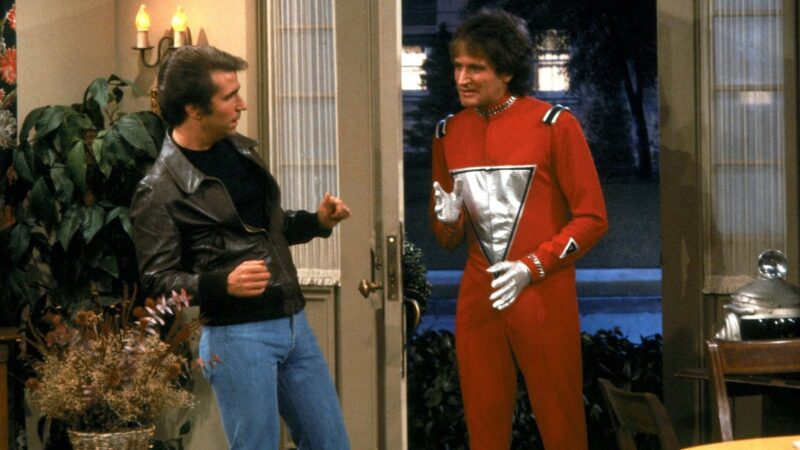
A show about a hyperactive alien sprung from an egg-shaped spaceship and a nostalgic sitcom set in the ’50s wouldn’t seem to have much in common, yet somehow “Mork & Mindy” owes its lead character to “Happy Days.” In an episode that spoofed the older sitcom “My Favorite Martian” and was inspired by an episode of “The Dick Van Dyke Show” involving a dream of aliens, all-American boy Richie Cunningham (Ron Howard) dreams about the alien Mork (Robin Williams) trying to kidnap him.
“Mork & Mindy” lasted only four seasons, and “Happy Days” was still running by the end. While the latter’s signature character, Fonzie, was the epitome of cool, Williams became a bona fide megastar thanks to his breakthrough role as the hyper-dork from planet Ork. Unknown when he originally got the part, he instantly made a mark with his manic improvising and mile-a-minute delivery.
The sitcom itself, which featured Mork falling in love with human housemate Mindy (Pam Dawber), got weird, with touches like Jonathan Winters playing their aging-in-reverse son Mearth and bizarre time travel plots toward the end. Even as ratings faltered, with executive tinkering behind the scenes making the scripts feel inconsistent, Williams’ comedy star rose.
It all started with a nonsense alien catchphrase that nobody who watched “Mork & Mindy” — or lived through it — can forget: “Na-Nu Na-Nu!”
The Simpsons
It’s the longest-running scripted American TV series ever, and one of the reasons it exists is that creator Matt Groening was scared he’d lose the rights to his syndicated comic strip “Life in Hell.” Instead of pitching those rabbit characters outright to producers Ken Estin and James L. Brooks, who wanted to animate them as show bumpers. He showed them the Simpson family.
Estin and Brooks wanted the cartoons for “The Tracey Ullman Show,” a sketch comedy variety program showcasing the English comic’s multiple characters. There would also be celebrity guests and animated segments to transition between bits. Those segments were “The Simpsons” and Klasky-Csupo’s “Dr. N!Godatu.” We all know which one quickly became more popular: the irreverent family was realistically dysfunctional but loving in a way few live-action sitcoms had the honesty to portray. Yet it wasn’t overly nihilistic like “Married… with Children.”
Indeed, “The Simpsons” caught on more than any of Ullman’s characters. They quickly became so well-liked that they were given an animated Christmas special, and the rest is TV (and merchandising) history, as the yellow-skinned clan became the faces of the Fox network, Butterfinger commercials, and insolent T-shirts banned in some high schools. President George H.W. Bush name-checked the show, albeit as an example of what families should not be. They’ve prevailed through every presidency since, even arguably predicting the current one.
Melrose Place
In 1992, “Beverly Hills, 90210” might have been the coolest zip code on network TV. The tale of two Midwestern teens transplanted to the elite SoCal neighborhood had teenage girls debating who was hotter between Jason Priestley and Luke Perry, and teenage boys undecided about whether they loved or hated Shannen Doherty’s Brenda. “90210” had its share of shocking drama, but as a show about (really old-looking) high schoolers, it couldn’t get too crazy. That was hardly the case for its adult spin-off, “Melrose Place,” set in a shared apartment complex, which hit its stride when it began embracing wild soap opera twists with a vengeance.
One of the first storylines to suck viewers in involved nerdy Billy (Andrew Shue) wanting out-of-his-league Alison (Courtney Thorne-Smith), but just as she finally became interested back, he dated her boss Amanda (Heather Locklear) instead. Amanda went on to buy the titular apartment complex and become involved with just about every man on the show. Subsequent storylines involved psychotherapist Kimberly Shaw having a split personality and later developing brain cancer, Kristin Davis’ character Brooke hitting her head and drowning in the complex pool, Billy’s subsequent fiancée Samantha having a criminal father, and more.
“Beverly Hills, 90210” was never meant to represent actual reality, but it gave lip service to trying to be serious. “Melrose Place” tried that at first, but soon found that ratings increased as the plots grew more outrageous. In the end, that made it a more fun show.
The Flash
When The CW initially promoted its then-new show “Arrow,” few casual viewers would have recognized that this was the DC Comics character Green Arrow. Ads seemed more interested in showing star Stephen Amell not just out of costume, but out of his shirt as well. In 2012, only months after the release of the first “Avengers” movie, the network hadn’t yet realized how lucrative superhero content would become.
When the Flash appeared on “Arrow” as a special guest character, there was no longer a stigma around superheroes, and the shared reality we’d come to know as the Arrowverse began with his spin-off. As played by Grant Gustin, Barry Allen was the fastest man alive, but he couldn’t outrun his solidly superheroic roots. Before the show began in 2014, Warner Bros. was working on a “Flash” movie. By the time it ended in 2023, the movie’s release was still a month away, though Ezra Miller’s Flash had already made a cameo on the TV show.
“The Flash” movie unsuccessfully tried to justify a DC movie Multiverse; TV’s “The Flash” was already a part of one, which would ultimately include shows like “Legends of Tomorrow,” “Supergirl,” and “Batwoman.” With fan-favorite star Gustin at the center, this Flash built his own crime-fighting family and took on multiple evil speedsters, as well as some extremely comic booky bad guys like Gorilla Grodd. “Arrow” didn’t take long to shed any perceived embarrassment at costumes and capes, but “The Flash” never had to.
Pinky and the Brain
As described during its opening credits song, “Animaniacs” was indeed a cartoon that was zany to the max. Throwback characters Yakko, Wakko, and Dot didn’t just create mayhem; they occasionally also taught us a thing or two, like when Yakko fit the names of every country in the world into a single song. “Animaniacs” didn’t just feature its title characters, though. Many recurring segments featured less successful premises, including one-joke characters like “Goodfeathers” (pigeons who talked like “Goodfellas”) and “Rita and Runt,” which featured a dog who talked like Dustin Hoffman in “Rain Man.”
The show hit gold, though, with its creation of “Pinky and the Brain,” two genetically modified lab mice who constantly try to take over the world. Inspired by coworkers of creator Tom Ruegger, the characters also reflected their voice actors’ obsessions: Maurice LaMarche with Orson Welles, and Rob Paulsen with Monty Python. It was a perfect blend that led to a spin-off show of their very own.
Having their own longer stories allowed “Pinky and the Brain” to get really weird, like spoofing both “Hamlet” and “Winnie the Pooh” in a single episode and attempting to take over the world, as usual, through means that ranged from mind-control Christmas toys to deals with Satan. The Brain may be a genius and Pinky insane, but their show was both.
Xena: Warrior Princess
Even before Kevin Sorbo became an annoying Twitter user, “Xena: Warrior Princess” was the superior show to its predecessor, “Hercules: The Legendary Journeys.” Sorbo never seemed quite in on the joke, while Lucy Lawless definitely was, which may be why producer Sam Raimi continues to cast her and not Sorbo. Even in 1995, the CG monsters didn’t look especially real, so “Hercules” leaned into an anachronistic tone and never took the material entirely seriously. Sorbo as Hercules seemed stuck in a noncommittal middle ground between playing silly and serious, while Lawless as Xena committed fully, ridiculous shrill shriek and all.
Despite the fact that the major characters on both shows were walking around scantily clad, it was “Xena” that winked at the audience that she and sidekick Gabrielle might be more than just casual friends – Hercules and Iolaus, not so much. To be fair, in the ’90s that sort of double standard was pretty par for the course, but Sorbo’s subsequent career in evangelical Christian movies suggests he’d never have gone for anything like that.
For fantasy nerds, it also helps that Xena is a new character and a blank slate as far as mythology goes. Sorbo’s Hercules, fairly or not, had to bear the weight of expectations from both Greek mythology and Steve Reeves. In the end, he’s just one of many — but Xena was an original, and with a female co-lead, her show passed the Bechdel test many times over.
Spin-Offs Que Superaram As Séries Originais
É comum que os telespectadores se apaixonem por personagens e histórias, mas às vezes, essas histórias derivadas conseguem brilhar mais do que as originais. Com o crescimento do interesse em universos expandidos, certos spin-offs não apenas justificam sua existência, mas se tornam ícones por si mesmos. Vamos explorar algumas dessas pérolas da televisão.
Frasier: O Intellecto que Encantou
Originado de “Cheers”, “Frasier” traz o psicólogo Frasier Crane de volta à tela, colocando-o em um novo cenário. O que se esperava ser uma continuação simples rapidamente se transformou em uma crítica social repleta de humor inteligente. A dinâmica entre Frasier e seu pai, Martin, junto com o irmão, Niles, cria uma rica tapeçaria de conflitos e risos, elevando a narrativa muito além da série de origem.
She-Ra: Muito Além das Expectativas
Quando “She-Ra: Princess of Power” foi lançada, a série rapidamente se destacou como um exemplo de como um spin-off pode subverter expectativas. A versão animada intitulava personagens de um mundo mais sombrio e interessante, deixando de lado o tom infantil do original “He-Man”. A luta de She-Ra contra um regime totalitário trouxe uma profundidade emocional rara para um desenho animado da época, provando que histórias relevantes podem se originar de plataformas infantis.
The Colbert Report: A Grande Satirista
Stephen Colbert, famoso por suas aparições no “The Daily Show”, trouxe seu personagem à vida em “The Colbert Report”. Nessa série, ele parodia um apresentador conservador, transformando o humor político em uma narrativa intensa e provocativa. Esse spin-off não apenas expandiu o universo da satire, como se estabeleceu como um marco na cultura política e na comédia, atraindo uma base de fãs leal e fervorosa.
Star Trek: Strange New Worlds: Uma Nova Fronteira
“Star Trek: Strange New Worlds” catapultou a franquia a novas alturas, alicerçado nos personagens clássicos e em narrativas episódicas. Esta série revisita o espírito aventureiro do original, permitindo uma exploração mais rica de temas humanos e científicos. As histórias autônomas que capturam dilemas morais em cada episódio atraem tanto novos espectadores quanto fãs de longa data, mostrando que a fórmula de “Star Trek” ainda tem muito a oferecer.
Mork & Mindy: O Alienígena que Conquistou Corações
A série “Mork & Mindy” nasceu de uma simples participação de um alienígena em “Happy Days”, mas rapidamente se tornou uma das comédias mais icônicas dos anos 70. A performance única de Robin Williams trouxe um frescor à televisão, combinando humor físico e um toque de surrealismo. A dinâmica entre Mork e Mindy explorou o amor e a amizade de maneira leve e envolvente, capturando a imaginação do público.
Os Simpsons: A Família Tão Peculiar
Os “Simpsons” começaram como uma breve sketch em “The Tracey Ullman Show”, mas a proposta logo se tornou uma série autônoma que revolucionou a animação na televisão. Com personagens memoráveis e sátiras afiados, o programa aborda questões sociais e políticas com irreverência, provando seu valor absolutamente além da série de origem. Como resultante, tornou-se um dos maiores fenômenos culturais da história da TV.
Melrose Place: Drama e Rebeldia
“Melrose Place” trouxe um novo nível de drama e complexidade às histórias de adolescentes com sua narrativa voltada para os adultos. O show explorou temas de amor, traição e rivalidade em um contexto mais maduro, muito além de “Beverly Hills, 90210”. Com reviravoltas inesperadas e tramas envolventes, conquistou uma audiência fiel que ansiava por mais do drama centrado em uma comunidade compartilhada.
The Flash: A Velocidade da Superação
Quando “The Flash” surgiu como um spin-off de “Arrow”, ofereceu aos fãs a chance de um novo herói no mundo dos super-heróis. Com Grant Gustin no papel principal, a série conquistou corações apresentando histórias envolventes e emocionantes que expandiram a narrativa do Arrowverse. A capacidade de capturar a essência da comédia e desafios da vida real, enquanto incorpora ação e aventura, fez de “The Flash” um fenômeno por si só.
Pinky e o Cérebro: Genialidade em Dose Dupla
O sucesso “Animaniacs” rendeu outro spin-off notável com “Pinky e o Cérebro”. Com dois ratos ambiciosos tentando conquistar o mundo, a série combina humor inteligente com uma crítica social perspicaz. A dinâmica única entre os personagens e suas tramas absurdas capturaram a atenção do público, tornando-se um clássico cult que ressoa em várias gerações.
Xena: A Guerreira que Mudou o Jogo
Substituindo “Hercules: As Jornadas Legendárias”, “Xena: Warrior Princess” não só se destacou como uma série icônica, mas também uma obra que trouxe uma nova perspectiva sobre as histórias de heroínas na televisão. Com seu forte arco narrativo e desenvolvimento de personagens, pérolas de ação e uma forte liderança feminina, “Xena” não apenas conquistou fãs, mas influenciou gerações futuras de personagens femininas na mídia.
Cada um desses spin-offs não apenas teve um impacto duradouro, mas também provou que histórias novas podem surgir das mais inesperadas origens. O que impulsiona o público a continuar assistindo não é apenas a familiaridade, mas também a qualidade e inovação que essas novas narrativas trazem.